Stucco Spraying
By Stucco Champions··3 min read
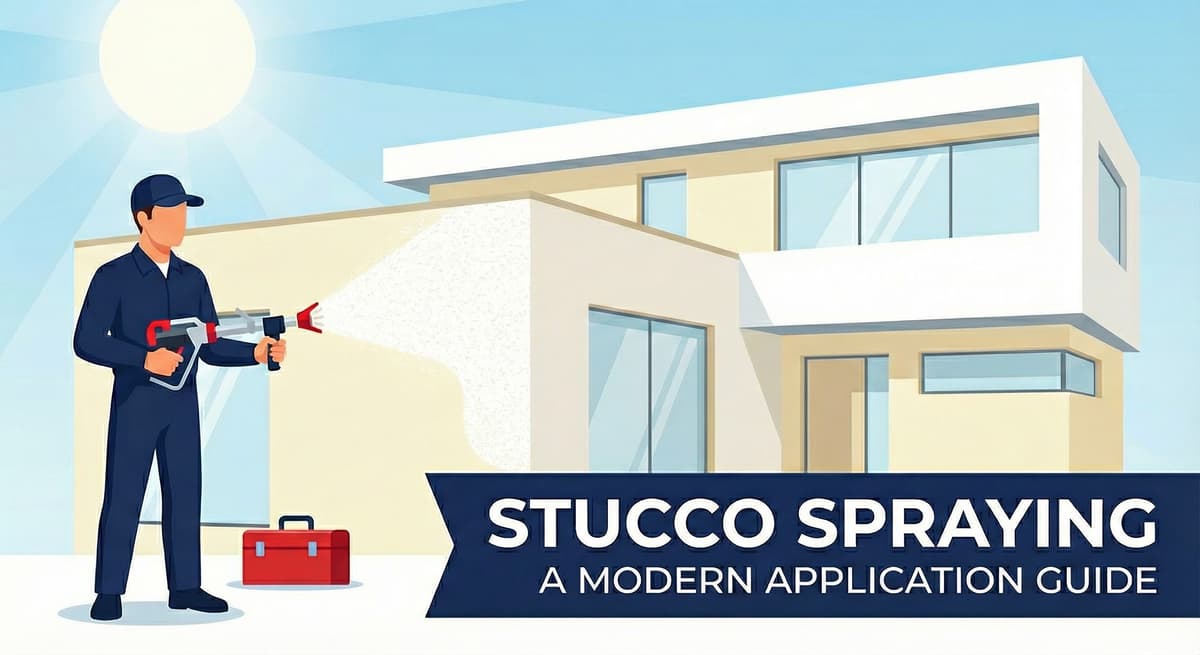
Written by Stucco Champions — Southern California’s Authority on Exterior Plastering.
The Mechanics of Stucco Spraying: Tools, Techniques, and Textures
When most people visualize stucco application, they picture a plasterer on a scaffold with a hawk and trowel, laboriously spreading cement by hand. While this traditional method is still used for high-end smooth finishes, the modern industry relies on Stucco Spraying. Spraying is faster, more consistent, and allows for textures that are impossible to achieve by hand. However, it requires a clear understanding of the equipment. You cannot use a drywall hopper to spray a base coat, and you cannot use a concrete pump to spray a fine lace finish. This guide breaks down the machinery.1. Base Coat Sprayers (The Heavy Lifters)
The Scratch and Brown coats are the structural layers of the wall. They are thick (3/8" to 1/2") and heavy. The Tool: Industrial Stucco Pump (e.g., Putzmeister, Mayco) or a Handheld Mortar Sprayer (Toolcrete). How it works: These machines use high pressure to blast heavy cement onto the lath. This force drives the mortar deep into the wire mesh, creating a stronger mechanical bond than hand application. ⚠️ CFM Requirement If you are using a handheld mortar sprayer, you need a massive air compressor. These tools require 12+ CFM at 90 PSI. A standard pancake compressor will not work; you need a gas-powered or 220v industrial unit.2. Finish Coat Sprayers (The Artists)
The final layer is thin (1/8") and decorative. The Tool: Hopper Gun (e.g., Marshalltown Sharp Shooter). How it works: Gravity feeds the material into an air stream that atomizes the stucco into droplets. By adjusting the air pressure and nozzle size, we can create different textures:- High Pressure / Small Nozzle: Fine Fog or Sand Finish.
- Low Pressure / Large Nozzle: Heavy Dash or Knockdown (Lace) Finish.
3. The Drywall Hopper Myth
Many DIYers ask: "Can I use my drywall texture gun for stucco?" The Answer: Only for very specific finishes. Drywall guns are plastic and designed for lightweight joint compound. They can handle fine cement finishes (20/30 silica sand), but they will clog instantly with coarse sand finishes (16/20). They absolutely cannot spray base coat stucco; the weight will crack the hopper.4. The "Gun and Spread" Technique
Spraying gets the material on the wall, but it doesn't finish it. The Protocol: 1. The Gunner: Sprays a uniform layer of stucco onto the wall. 2. The Spreaders: A team follows immediately behind with trowels to flatten (knock down) the texture or smooth it out. This hybrid method combines the speed of spraying with the precision of hand-tooling.Conclusion: The Right Tool for the Job
Spraying stucco is not a shortcut; it is a technique. Used correctly, it creates a denser, more uniform wall than hand application alone. Whether you are looking for a "Machine Dash" finish or just want to speed up a block wall project, selecting the right sprayer is the first step to success. Related Resources Last week, we shared Is It Possible to Grind Stucco? If you made a mistake spraying, read this to learn how to fix it.Stucco Spraying