Stucco Textures & Finishes: Expert Guide for Contractors
Written by Stucco Champions — Southern California’s Authority on Exterior Plastering.
Stucco Textures & Finishes: An Expert Guide to Southern California Styles
In Southern California, the texture of your stucco is just as important as the color. It defines the architectural era of the home, impacts the maintenance budget, and determines how well the building ages.
We often see homeowners struggle to articulate what they want. Is it "Smooth"? "Rough"? "Old World"? This guide decodes the industry terminology for the most common finishes found from Santa Barbara to San Diego, helping you choose the right skin for your home.
1. The "Big Three" (Common Residential Textures)
Free Assessment
Noticing Stucco Damage?
Get a free on-site assessment from a licensed contractor. $0 deposit, no obligation.
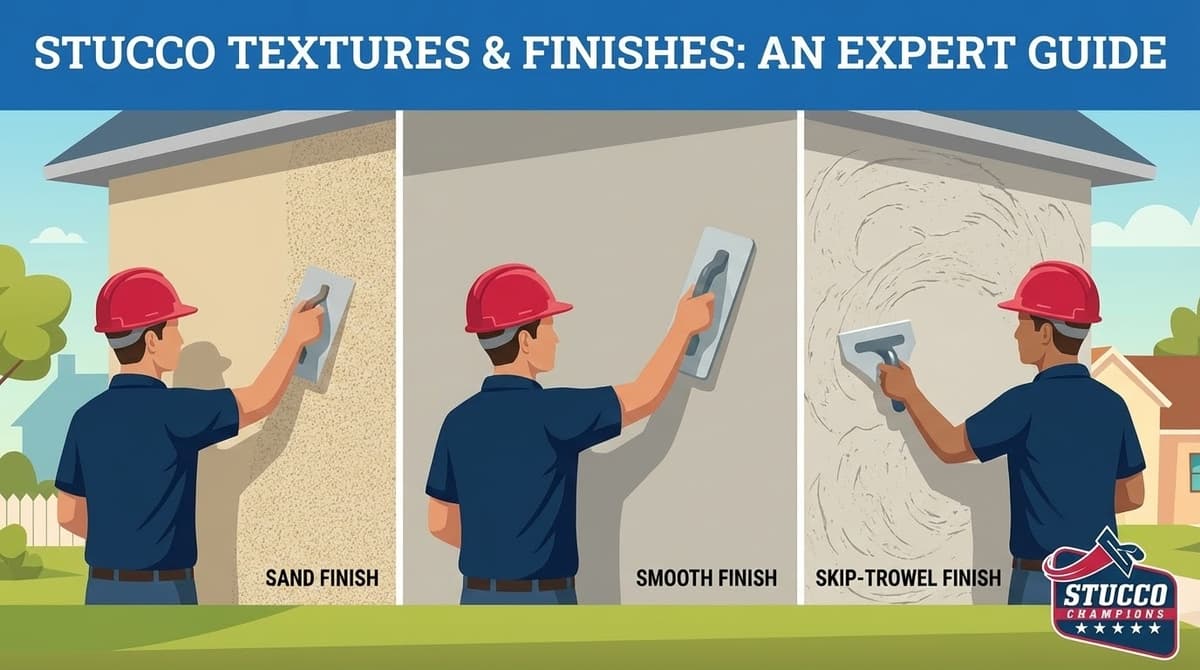
GET FREE ASSESSMENTSpanish Lace / Skip Trowel
The Look: This is the quintessential "California Stucco." The plasterer trowels a base coat and then "skips" the trowel over the surface, leaving irregular, flattened islands of texture.
Best For: Hiding imperfections. Because the texture is random and heavy, it is excellent for camouflaging wavy framing or patch repairs. It is low maintenance and forgiving.
Sand Finish (Float Finish)
The Look: A uniform, gritty texture that resembles sandpaper. It is crisp, clean, and modern.
Aggregate: We can adjust the roughness by changing the sand size.
Fine (20/30 Mesh): Tight and modern.
Coarse (16/20 Mesh): heavy and commercial.
Best For: Contemporary homes or Craftsman bungalows. It requires a skilled hand to avoid "swirl marks" from the float.
Dash Finish (Knockdown)
The Look: A pebbled, popcorn-like texture sprayed onto the wall with a hopper gun.
Application: It can be left rough ("Machine Dash") or flattened with a trowel ("Knockdown").
Best For: Tract homes and commercial buildings. It is fast to apply and very durable, though harder to clean due to the deep crevices.
2. The Premium Smooth Finishes
Santa Barbara Finish (Smooth)
The Look: Modeled after the adobe estates of the California coast. It is semi-smooth with undulating waves and "cat faces" (small voids) that give it character.
Best For: Spanish Revival and high-end Mediterranean custom homes.
True Smooth (Hard Trowel)
The Look: Glassy, polished, and uniform.
The Cost: This is the most expensive finish. It requires multiple passes with a steel pool trowel to burnish the cement. It shows every imperfection in the wall.
Smooth stucco will crack. Without the rough aggregate (sand) to relieve surface tension, hairline spiderweb cracks are inevitable. While we use fiber-mesh and acrylic modifiers to minimize this, homeowners choosing smooth stucco must accept that cracking is a characteristic of the material, not a defect.
3. Specialty & Retro Textures
Cat Face (Montalvo)
The Look: A smooth surface interrupted by rough "peeks" or inclusions of the base coat.
Style: Very popular in Tuscan designs. The ratio of smooth-to-rough can be customized (e.g., "Heavy Cat Face" vs. "Light Cat Face").
Worm / Swirl (Putz)
The Look: A retro finish common in the 70s. Large pieces of aggregate are dragged in a circular motion by a plastic float, leaving "worm tracks" in the cement.
Note: This is rarely applied new today but is often encountered during patch repairs.
4. Material Selection: Acrylic vs. Cement
The texture you choose often dictates the material we use.
- For Lace & Cat Face: We prefer Traditional Cement. It allows for depth, build-up, and natural color mottling.
- For Sand & Smooth: We often recommend Acrylic (Synthetic) Finish. Acrylics are flexible and resist the hairline cracking that plagues smooth cement walls. They also offer perfect color uniformity.
Conclusion: Choose Wisely
Your texture choice is a permanent commitment. A rough Dash finish is nearly impossible to smooth out later without expensive grinding and skim coating. Conversely, a Smooth finish requires a higher maintenance budget. At Stucco Champions, we provide physical sample boards so you can see exactly how the light hits the texture before we apply it to your home.
Related ResourcesLast week, we shared Different Stucco Trowels and Their Uses. The tool in the plasterer's hand determines the texture on your wall.
See How Different Textures Look on Your Home
Our Stucco Visualizer lets you preview finishes on a real home before you commit.